
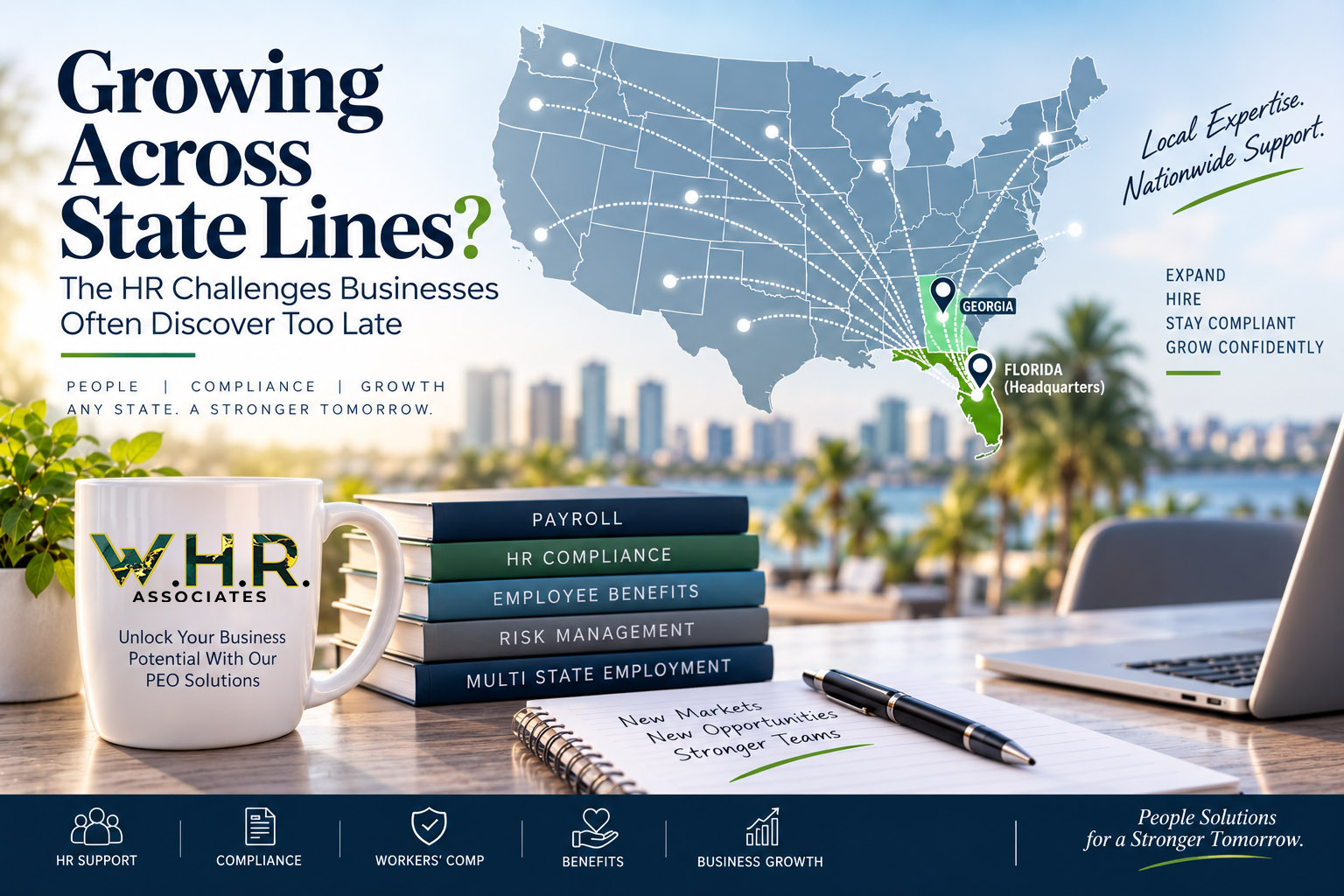
Growth is usually a good problem to have.
A new customer leads to another location. A great candidate happens to live in another state. A company that once operated from one office suddenly has employees working from several parts of the country.
The opportunity is exciting. The administrative side can be considerably less exciting.
Hiring an employee in another state can introduce new requirements involving payroll taxes, workers’ compensation, wage and hour rules, paid leave, employee classifications, required notices and other employment practices.
For a growing business, the important question is no longer simply, “Can we hire this person?”
It is also, “Are we prepared to employ this person where they live?”
One Employee Can Change the HR Picture
Businesses do not need to open a new office to become a multistate employer.
Remote work has changed that.
A company headquartered in one state may hire a salesperson, manager, technician or administrative employee who works from home hundreds of miles away. That single hire can create responsibilities in another jurisdiction.
As the company continues to grow, the situation can become increasingly complicated. Requirements that apply to one employee may not apply in exactly the same way to another.
This is why HR planning should be part of a company’s growth strategy, rather than something addressed after the hiring decisions have already been made.
Payroll Becomes More Than Issuing Paychecks
Payroll may appear straightforward from an employee’s perspective. They work, taxes are withheld, and they receive a paycheck.
Behind that paycheck is a much larger process.
Employers may need to account for state and local withholding requirements, unemployment insurance, wage rules, overtime requirements, and employee classifications.
Mistakes can become expensive, particularly when they are repeated across multiple payroll periods.
The goal is not simply to process payroll on time. It is to have a payroll process that can grow along with the business.
Workers’ Compensation Needs to Grow With You
Workers’ compensation is another area that can become more complicated when a company expands.
Requirements and insurance considerations can vary based on where employees work and the type of work they perform.
Companies also change over time. A business that once had five employees performing similar jobs may eventually have office employees, drivers, field personnel, supervisors and employees working in several states.
That makes accurate job classifications, payroll reporting and risk management increasingly important.
A strong workers’ compensation strategy should evolve with the workforce rather than remain unchanged as the company grows.
Your Employee Handbook May Need to Change Too
An employee handbook should not be treated as a document that is written once and forgotten.
As businesses add employees and enter new states, policies may need to address different requirements concerning paid leave, sick time, breaks, workplace notices and other employment practices.
There is another reason to review policies regularly: the way people work continues to change.
Remote work, flexible schedules, electronic communication and new technology have changed many workplaces considerably in just a few years.
Company policies should reflect the business you operate today, not the business you operated five years ago.
Benefits Matter When Competing for Employees
Growth creates another challenge: attracting and keeping good people.
Salary is important, but employees also look at the overall employment package. Health benefits, retirement options, paid time off and access to HR support can all influence how an employee views an opportunity.
For smaller and midsize businesses, competing with the benefits offered by much larger organizations can be difficult.
This is one reason many businesses consider working with a Professional Employer Organization. A PEO can bring payroll, HR support, employee benefits, workers’ compensation and risk management resources together under a more coordinated approach.
It allows the business owner to spend less time trying to manage separate administrative systems and more time running the company.
Growth Should Not Create Administrative Chaos
There is a point in the life of many businesses when handling HR internally starts taking more time than anyone expected.
The owner is answering employee questions. Someone in accounting is handling payroll issues. A manager is trying to interpret a policy. Insurance questions are going to another person entirely.
Each individual task may seem manageable.
Together, they can become a distraction from running the business.
The better approach is to build the HR infrastructure before administrative problems begin interfering with growth.
Before Hiring in Another State, Ask the Right Questions
Before adding employees in a new state, business owners should understand what that expansion may require.
Is the company properly set up to run payroll there? Does its workers’ compensation coverage apply appropriately? Are there state specific employment requirements? Do existing policies need to be updated? Can the current benefits program accommodate the new employees?
Those questions are much easier to address before an employee’s first day than several months afterward.
Build the Business. Let the HR Infrastructure Keep Up.
Growth should create opportunities, not an ever expanding list of administrative headaches.
W.H.R. Associates works with businesses that want a more efficient way to manage payroll, human resources, workers’ compensation, employee benefits and risk management. Whether your employees are in one state or your workforce is expanding across the country, having experienced support behind the business can make growth easier to manage.
Ready to see whether your HR infrastructure is keeping pace with your business? Contact W.H.R. Associates to start the conversation.